Before the Prompt Book: How Stage Directions Found Their Place
How stage directions found their place helps readers distinguish the playwright’s text from editorial notes and production choices, making scripts easier to interpret.
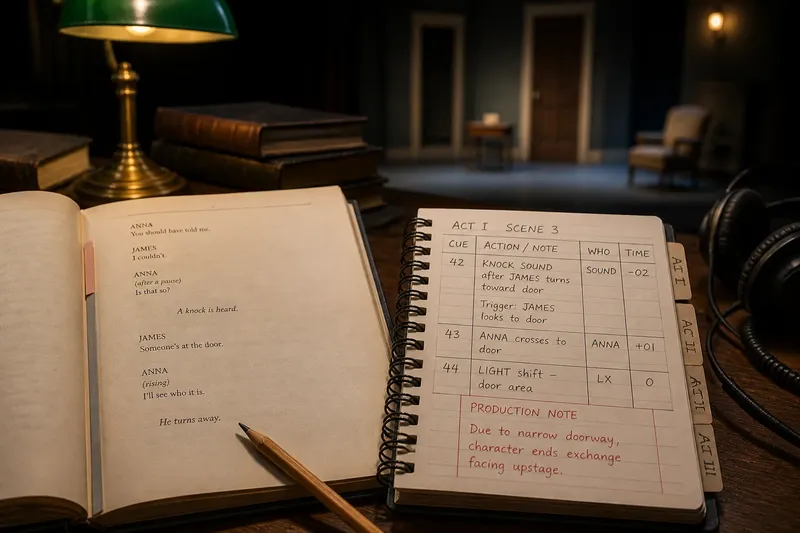
A rehearsal copy lies open beside a prompt book. One page says a door opens; the other notes the cue and timing that make it happen in this production. How stage directions found their place is best understood by keeping those two records distinct: one belongs to the play’s text, the other to a company’s working version.
Stage directions vary with the script and its edition
A printed play does not always preserve a complete account of how an earlier performance looked or sounded. Some scripts give extensive descriptions; others provide brief notes for entrances, exits, or visible actions. The amount and kind of information depend on the particular text and edition, so broad claims about an entire period can obscure important differences.
A sparse page does not establish that performers made few choices. It tells a reader that the surviving text records those choices selectively. Dialogue, rehearsal practice, company conventions, and the demands of a performance space may all have contributed to the action, though the page alone may not show how.
When reading an older play, identify the edition and distinguish what it prints from what you can infer about performance.
Printed directions need a source-aware reading
A stage direction in a published edition might reflect the playwright’s wording, an editor’s intervention, or material carried forward from another source. Without evidence about a specific text, it is safer not to assign every note to a single author or theatrical tradition.
Compare editions when a direction materially affects interpretation. Check prefaces, editorial notes, and other documentation that accompanies the text. If the source remains unclear, record the direction as part of the edition in hand rather than presenting it as unquestionably original.
This distinction matters in rehearsal. A note may specify an observable event, such as a character leaving, or offer a less concrete suggestion about mood. The company can discuss what the text requires and what an edition proposes without confusing the two.
Keep the wording, source, and production interpretation separate in your notes.
Production records answer a different question
A script describes a play as it is presented in that text. A prompt book records the practical choices used to run a particular production, such as cue placement, entrances, scene changes, and agreed timing. It can preserve useful working knowledge, but it is not automatically a fuller or more authoritative version of the play.
Imagine a rehearsal copy with the direction “A knock is heard.” The stage manager adds a clearly marked production annotation: the sound operator takes the cue after the actor turns toward the door. In the resulting prompt book, a later performance can reproduce that company’s sequence, while a reader can still tell that the cue timing was a production decision, not necessarily part of the published direction.
Use separate labels or layers for printed text and production annotations. That small distinction helps a future company understand what it is free to reconsider.
How should a company assess a direction?
Should a company follow every direction literally?
First identify what the direction contributes to the scene: an event, a relationship, a rhythm, or information the audience needs. If a literal staging choice is not practical, discuss an alternative that preserves that function and make the agreed choice clear in the production record.
What should a reader do when editions differ?
Compare the relevant passages and consult editorial notes or other documentation that comes with the editions. If the difference remains unresolved, keep both readings visible in discussion rather than treating one as certain without support.
What belongs in a prompt book?
Record the repeatable cues and decisions that the company needs to run its production, and identify them as production annotations. Leave the published wording distinguishable so later readers can see which details belong to the text and which belong to this staging.
How can a company handle a direction that is hard to stage?
Separate the direction’s concrete event from any effect the company believes it serves. Discuss a workable alternative with the director and relevant production staff, then record the chosen version and any cue needed to repeat it.
A short review can keep the records legible
Before rehearsals settle into a routine, a company can review how it will handle directions and annotations. Each observation should lead to a clear choice, including an alternative if the first option does not fit.
- Check the edition named on the script. If it is identified, use its notes when interpreting disputed directions; if it is not, record that uncertainty and avoid presenting editorial wording as confirmed authorial text.
- Check whether a direction is dialogue, printed stage direction, or added annotation. If its status is clear, preserve that label; if not, mark the uncertainty and consult the edition’s documentation.
- Check whether the direction names an observable event. If it does, agree how that event will appear onstage; if it does not, discuss the possible dramatic function before choosing a physical or sonic interpretation.
- Check whether the proposed action fits the space and available resources. If it does, retain it as a workable option; if it does not, develop an alternative with the relevant production staff and record the agreed version.
- Check whether a cue needs repeatable timing. If it does, mark its trigger and sequence in the prompt book; if it does not, avoid adding unnecessary timing instructions to the play text.
- Check whether a note could be mistaken for printed text. If it could, distinguish it with a consistent annotation method; if it cannot, still identify production-specific decisions so later readers know their source.
Say a company is working from an edition that prints “He turns away,” while its rehearsal space has a narrow doorway that makes the proposed movement awkward. The director first checks the edition’s notes and finds no explanation for the direction’s source, so the company treats it as printed wording without assuming more. The actors then discuss the scene’s immediate action and agree that the character should end the exchange facing away from the other person. The stage manager records that agreed position as a production choice, separate from the printed direction. The result keeps the visible change in the scene while making clear which detail came from the edition and which came from rehearsal.
The page records choices without containing the performance
A direction can preserve a useful trace of theatrical action, but it cannot hold every detail of how a scene was performed. The record becomes more valuable, not less, when its limits and sources are visible.
How stage directions found their place is therefore also a question of who wrote, edited, or annotated each instruction. Read the script closely, consult its supporting notes when needed, and let the prompt book identify the choices that belong to one production. A clear record gives the next company room to make its own informed decisions.