Why a Scene Changes When an Actor Crosses the Stage
Why a scene changes when an actor crosses the stage: see how a carefully placed move redirects attention and alters a relationship without changing dialogue.
In a rehearsal room, a chair sits near the window, and two actors face each other across it. One actor says, “I thought you’d be here.” The other answers, “I am.” Nothing in the lines changes when the first actor walks around the chair. Yet the exchange can turn from a small reunion into an accusation, or from a challenge into an invitation. Why a scene changes when an actor crosses the stage is a question of attention: movement asks the audience to notice a new relationship between bodies, space, and words.
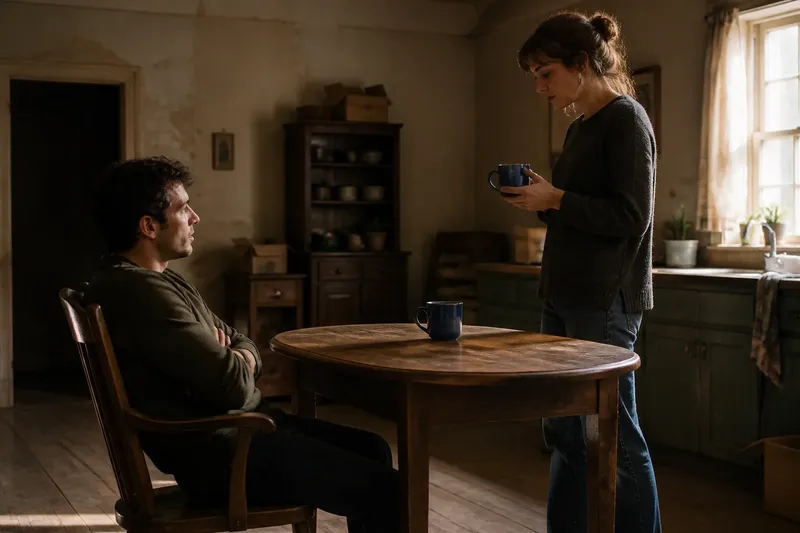
Consider an invented scene, not a report of an actual production. Mara and Eli are siblings clearing their late father’s kitchen. The scene gives them a modest task: decide whether to keep a chipped blue cup. The dialogue stays exactly the same throughout the walk-through. What changes is where each actor stands, where they look, and what the audience is invited to read into those choices.
The first arrangement lets the words carry the conflict
In the first version, Mara stands at the kitchen table with the cup. Eli sits on a chair several feet away. Their positions are easy to read: one holds the object, the other waits. Mara says, “It’s only a cup.” Eli replies, “You said that about the radio.” The audience can see both faces, but the space between them makes the conversation feel cautious. Each person has a place, and neither has yet disturbed the other’s.
The director does not need to call this distance “sad” or “angry.” Those labels can narrow the actors’ choices before they have explored the scene. A more useful observation is concrete: Eli is seated while Mara controls the cup; Mara can turn away without moving her feet; Eli must rise or remain where he is. The arrangement supplies playable facts. The actors can decide whether the stillness reflects restraint, fatigue, or a wish to avoid a fight.
Try the scene once without adding any movement. Keep the cup on the table and let the pauses remain. Notice where attention falls when a line lands, and whether the audience can see the listener’s reaction as clearly as the speaker’s.
A crossing gives the same line a new target
Now give Mara a reason to cross. She picks up the cup, walks around the table, and stops beside Eli. She delivers “It’s only a cup” while looking at the object rather than at him. Eli’s reply, “You said that about the radio,” now comes from someone who has had to turn toward her. The dialogue is unchanged, but the move has made Mara’s claim physically close to Eli’s memory. She may be trying to persuade him, or she may be trying to prevent him from answering. The audience has a sharper question to watch.
A crossing can alter emphasis because it changes the visual pattern. A seated figure beside a standing one looks different from two people facing across a table. The eye tracks a moving body, then notices the person left behind. That shift can make a listener’s stillness newly meaningful. Eli has not moved, but his refusal to stand may now read as resistance, hurt, or a decision not to meet Mara on her terms.
Movement does not automatically make a moment more important. A cross can distract from a line if it is busy, unmotivated, or timed so that the audience watches the actor’s feet instead of hearing the thought. Give the move a clear destination and let the line meet the move at a deliberate point: before the walk, during it, or after the actor arrives. Each choice directs attention differently.
The destination matters as much as the path
Suppose Mara crosses to Eli’s side but stops behind his chair. She now has proximity without face-to-face contact. If she says “It’s only a cup” from there, the line can sound protective, possessive, or evasive, depending on her focus and tone. The audience may watch Eli’s face, since he cannot easily look back without turning. A path that ends behind another actor creates a different image from one that ends beside them.
Imagine the actors begin at the table and chair, with the cup between them. Mara walks around the table and stops beside Eli, leaving the cup on the tabletop. She says, “It’s only a cup,” then looks at him. Eli answers, “You said that about the radio.” The expected observable result is not a fixed emotion. It is a clearer visual choice: the audience can see whether Eli meets her eyes, looks down, or turns toward the cup. That reaction can carry the weight of the exchange without another line.
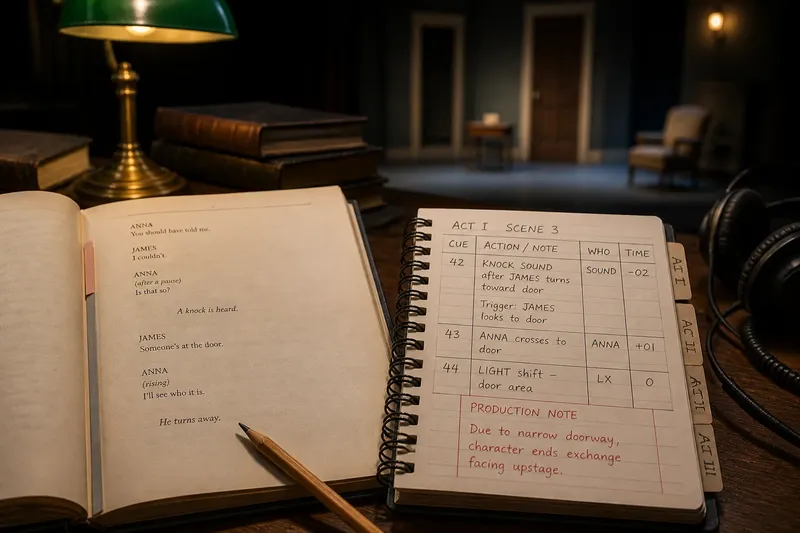
The route should also suit the room. A direct diagonal may feel open in a small studio but expose an actor’s back to much of a larger audience. A route around furniture may create a pause or give the other actor time to respond. The director can check the sightlines from several seats and ask whether the crossing reveals the face or hides the action that matters.
Rehearsal makes the movement legible
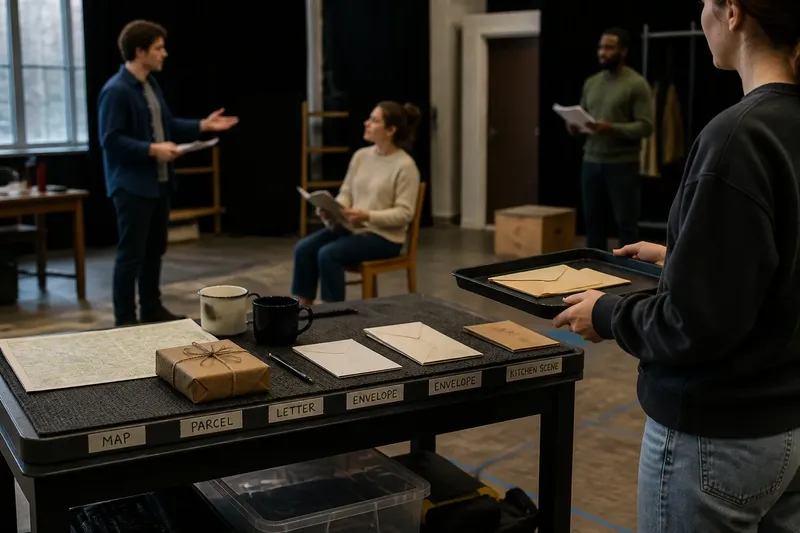
For this scene, a simple rehearsal sequence can separate the effects of blocking from the effects of acting:
- Set the table, chair, and cup in their intended positions. Confirm that both actors can reach the cup naturally.
- Run the dialogue with no crossings. Notice which line seems to change the temperature of the scene and what the actors do while listening.
- Repeat with Mara crossing before “It’s only a cup.” Keep the pace and vocal delivery as close as possible to the first run.
- Repeat with the crossing after the line. Compare whether the audience attends first to the words, the walk, or Eli’s response.
- Ask an observer where their attention went at the moment of the cross. Then adjust the route, timing, or stopping point rather than adding movement for its own sake.
This is not a formula for assigning meaning to every move. It is a way to see what the move makes available. If the crossing produces no useful change, remove it. If it makes Eli’s response visible, keep it and refine the timing. A small, repeatable action often serves a scene better than a series of decorative gestures.
When should an actor cross the stage?
Should a crossing happen on a line or between lines?
A cross on a line can make the words feel like the reason for the move, or give the line a physical destination. A cross between lines lets the audience watch the movement before the next thought arrives, so the next line may feel newly considered.
How can a crossing change the power between actors?
Power can shift when one actor closes distance, occupies a shared space, or makes the other turn to maintain contact. The move does not dictate who has control; the other actor’s response, including a refusal to move, shapes what the audience sees.
What if the audience cannot see the reaction?
Try changing the stopping point or angle so the listening actor’s face remains visible from the seats that matter. A useful cross should reveal the scene’s response, not simply carry an actor from one mark to another.
Does every scene need movement?
No. Stillness can hold attention when the actors’ listening and the scene’s arrangement are active. A crossing is worth keeping when it clarifies a relationship, redirects focus, or gives a line a changed context.
The final blocking choice should sharpen the audience’s question
Return to Mara and Eli. In the last version, Mara leaves the cup on the table, crosses to Eli’s side, and stops before speaking. She says, “It’s only a cup.” Eli looks at the cup, then at her, and answers, “You said that about the radio.” The blocking does not tell the audience what the siblings feel. It gives the exchange a readable shape: Mara chooses closeness, while Eli brings the ignored object back into view.
The director can now ask a more precise question than “Does this look natural?” Does the cross make the audience watch the cup, Mara, or Eli at the point when the scene needs attention? If the answer changes across the room, adjust the path or the actors’ angles and look again. Why a scene changes when an actor crosses the stage comes down to the attention that movement organizes: who approaches, who stays still, what becomes visible, and which line arrives in a newly charged space. Choose the crossing for the question it leaves in the audience’s mind.