Props Table or Handheld Tray for Rehearsal Objects
Choose a props table or handheld tray for rehearsal objects by weighing cast movement, reset needs and access, so small items stay visible and returnable.
A rehearsal-room key vanishes beneath a script just as the actor reaches for it. The props table is close, but the scene has moved across the room. For rehearsal objects, choosing a labelled props table or a handheld tray is less about neatness than about matching storage to the action.
Both approaches can keep small items visible and easy to return. A table gives objects a fixed home; a tray brings that home to the people and places that need it. The useful choice depends on how often the objects move, who handles them, and how the rehearsal resets.
A labelled props table suits a stable playing area
Choose a labelled table when actors repeatedly collect and return objects from a consistent place. This is common when rehearsal is concentrated around a central table, a doorway, or a single side of the room. The fixed location becomes part of the room’s working map.
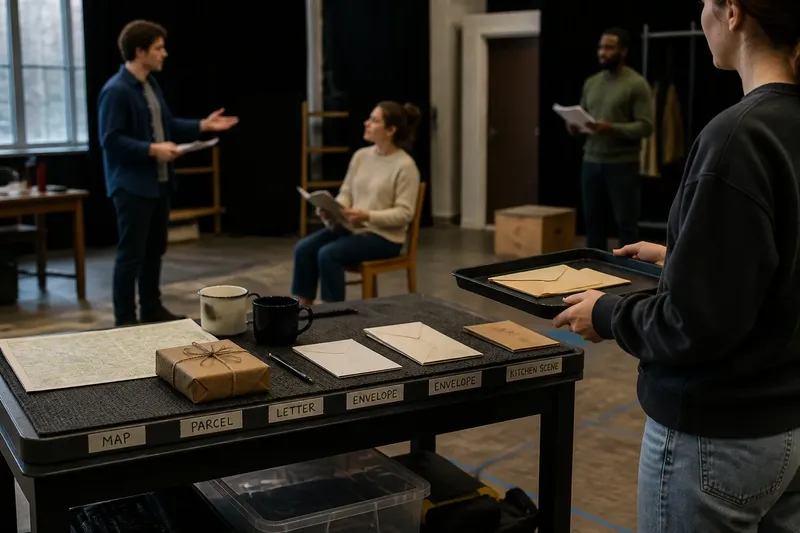
Arrange objects in the order and groupings that help users identify them at a glance. A shallow tray or non-slip mat can keep small pieces from drifting. Give each item a clear space, and use plain labels that describe the object or its scene, such as “envelope” or “kitchen scene.” Avoid labels that rely on one person’s private shorthand.
A labelled table is especially useful when several people may need to retrieve the same objects. The assistant stage manager, actors, and director can see what is present without asking where it went. It also makes the return location visible, which helps prevent an object from being set down on a chair or buried in a script pile.
Keep the table outside traffic paths and away from the acting area. The exact placement should reflect the room’s layout and any house rules. A tidy station is only helpful if reaching it does not interrupt a scene or create a hazard.
Choose a fixed station when the room’s geography stays consistent.
A handheld tray fits objects that travel with the action
Choose a tray when the objects are needed in different parts of the room or move between scenes. The tray can follow a rehearsal’s shifting focus: from a desk setup to a doorway, then to a chair used as a shop counter. Rather than asking the actor to cross back to a fixed table, the objects arrive near the next point of use.
A tray is also useful when a group is working in a small room with no safe, convenient table location. It can hold a compact set of rehearsal pieces together, making a scene change easier to manage. Select a tray with a stable base and sides that suit the size and shape of the objects. Keep its load light enough to carry comfortably.
The trade-off is that a tray needs a designated resting place when it is not in use. If it is carried away with an actor or placed behind scenery, other people may not know where the objects are. Assign one person to return it to a consistent parking spot, or give it a visible mark on the room map.
A tray travels well only when its resting place is just as clear as its route.
Use the table when shared access matters more than mobility
A fixed table is the better fit when people retrieve objects at different times, when there are several small items, or when the cast needs to see what belongs to each scene. It supports independent access: one actor can collect a letter while another returns a cup, without waiting for a tray to come back.
It is also the simpler choice for objects that should remain sorted between rehearsals. A labelled surface offers a quick visual check for missing pieces and makes it easier to restore the same arrangement after a break. If the room changes frequently, however, the table’s location may need to be reconsidered rather than assumed to be permanent.
Say a rehearsal uses a paper map, a wrapped parcel, and two envelopes in scenes spread across the room. Imagine the group keeps the map and parcel at a central desk while the envelopes are repeatedly carried to separate playing areas. A table would make the scene-specific grouping visible, while a small tray could bring just the envelopes to the next location. The expected observable result is less searching at the desk and a clear place for the pieces to return.
Use the tray when the handoff is part of the rehearsal flow
A tray fits when objects move as a group and one person can be responsible for carrying them. It can support a rehearsal that shifts between room layouts, especially when the group wants to avoid repeatedly walking back to a storage station. The tray can also keep a cluster of related objects together during a pause.
Do not use it as a substitute for clear ownership. If several people pick items up and carry the tray, its location can become uncertain. Agree who moves it and where it waits between scenes. For a production with many objects or frequent changes in who handles them, a table may be easier to supervise.
For fragile, sharp, breakable, or otherwise potentially hazardous items, follow the relevant label, manufacturer instructions, venue procedures, and local rules. Use an appropriate method of storage and handling rather than relying on the convenience of either a tray or a table.
Which setup fits your rehearsal room?
When should I choose a labelled props table?
Choose one when actors return to a dependable collection point and several people need to identify the same objects. It makes locations and returns visible without requiring a single person to carry the items.
When is a handheld tray more useful?
Choose a tray when a compact group of objects travels between playing areas or when no suitable fixed station is nearby. Give it a consistent parking place so it does not disappear between uses.
Can I use both a table and a tray?
Yes, if they have different jobs. Keep the full collection sorted on the table, then use a tray for the small group needed at a temporary rehearsal location.
What should I do if the room layout keeps changing?
Start with the option that is easiest to move without losing track of the objects. If the tray becomes difficult to locate or manage, establish a labelled station in the room’s most dependable area.
Make returning objects as clear as collecting them
Whichever setup you choose, agree on a return routine before objects start circulating. Decide who is responsible for putting items back, whether they return after each scene or at a break, and what to do with an object whose next use is unclear. A simple spoken rule is often enough, provided everyone follows the same one.
Then watch the rehearsal for small signs of friction: an actor searching before an entrance, a tray left in the traffic path, or an object returned to the wrong group. Adjust the layout in response. The right props table or handheld tray is the one that makes the next action obvious and the return just as easy.